
BALL PYTHON CARE SHEET
Python regius
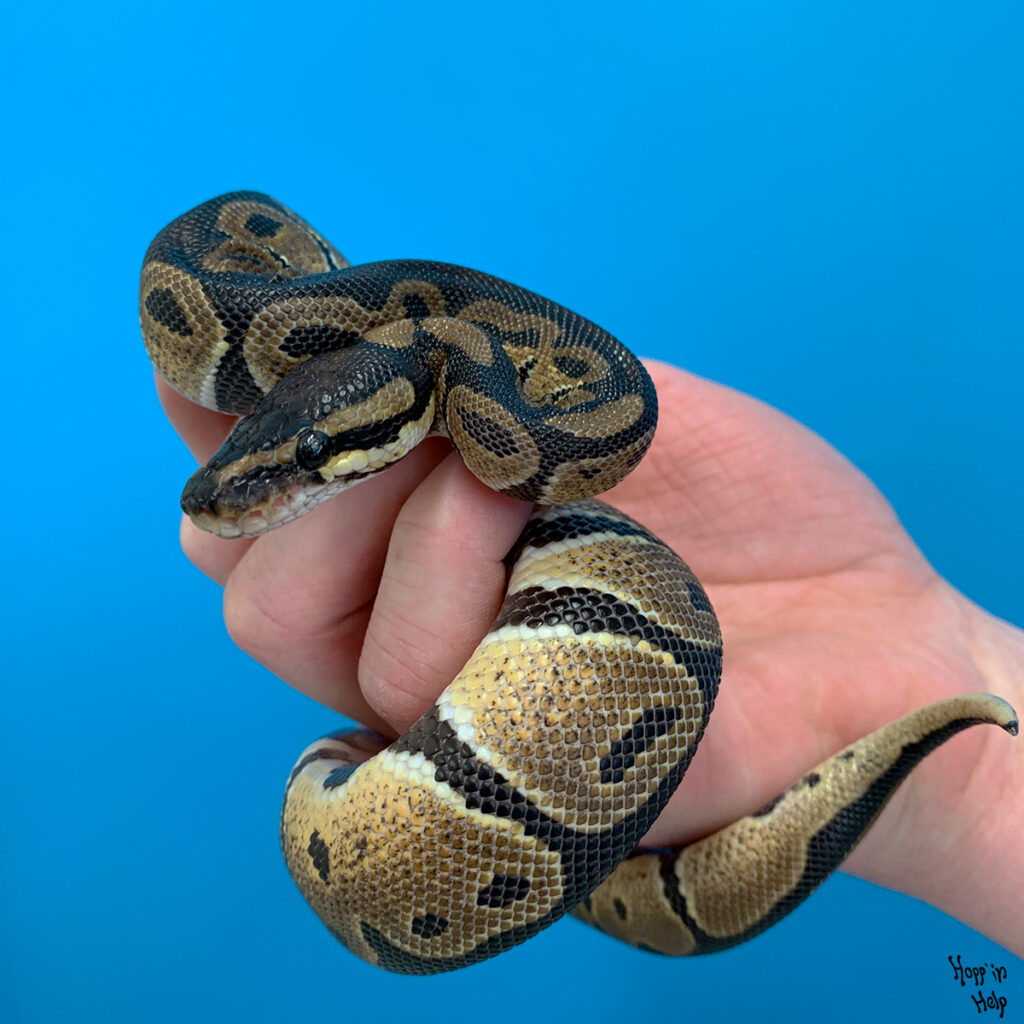
PERSONAL EXPERIENCE: Ball Python’s are incredibly docile species and a wonderful addition to your family. With a calm demeanor, adorable faces, and simple care requirements, they make great pets for beginners and experienced owners alike!
DIFFICULTY: Beginner
LIFE SPAN: 20-30 years with proper husbandry in captivity, some extending into their 40-50s.
ACTIVITY: Ball Python are crepuscular, meaning they are active at dusk and dawn. However, they tend to be most mobile in late evening hours. During the day, you will find your snake resting in their iconic “ball” position. Occasionally slithering to their basking spot for warmth. After sunset, they explore their enclosure and drink or soak within their water dish.
ENCLOSURE: Ball Pythons require a relatively simple enclosure compared to other species of reptiles, making them a great first reptile. However this is not an excuse to provide the bare minimum. While not described in this care sheet, bio-active enclosures are an incredible choice for Ball Pythons. These enclosures do require a certain level of skill and experience to properly create and maintain. If you are a beginner, you can always upgrade your husbandry after a few years of ownership!
Ball Pythons require a heat gradient. Reptiles are ectothermic, relying on environmental heat sources and moving in and out of heat to regulate their body temperature. Without a proper range of temperatures within their enclosure, your reptile will be unable to maintain homeostasis and develop secondary issues. One side of the enclosure will be the dedicated warm side, with your heat source. Opposite will be the cool side. It is recommended to place their water dish on this side to avoid excessive evaporation.
A variety of substrates may be utilized for your Ball Python. Loose soil substrates work well as they encourage natural behaviors. A mixture of coconut fiber and Reptibark or 70% top soil and 30% play sand (sanitized) work well. If using a loose substrate, be sure heavy decor is resting on the base of the enclosure to avoid a snake burrowing under and becoming crushed. For an easier to maintain vivarium, vinyl or paper towels have been used with success but make sure to provide adequate sources of humidity. Avoid “reptile carpet”, fabric holds and grows bacteria.
After adopting your snake, having a quarantine period is recommended if you own other animals. In this time, paper towels are recommended as the substrate over loose substrata. Have your snake seen by an exotic vet for an overall wellness exam and have a stool sample checked for parasites. Paper towels are easy to clean and can make treatment more successful. Suggested quarantine times range from 30 days to 1 year. At minimum, I recommend your new snake be seen by a vet and kept from other reptiles for 3 months to ensure there is no infection disease. If this is your first reptile, after a negative fecal test is acquired, meaning parasites are not present or treatment was successful, you may look into different substrates. I also recommend testing for Cryptosporidium, a highly contagious and often fatal disease. This is especially important if you plan on having more snakes in the future or are adding to your collection.
SIZE OF ENCLOSURE: Ball pythons grow rapidly in their first 3 years of life. A 20 Gallon long enclosure is suitable to a young Ball Python. A 40 Gallon Breeder enclosure is suitable for a juvenile to sub-adult snake. Adult Ball Python’s require a 4x2x2’ enclosure. Some owners elect to upgrade enclosures as the snake grows. You may also purchase the adult size enclosure for your young python. With ample cover with hides, plants, vines, and leaf litter, a small Ball Python will thrive within a large enclosure – though wellness checks and feeding may be a hide-and-seek game! Without proper coverage your python will experience stress that may result in hunger strikes or illness. Upgrading hides is recommended as your python grows into their enclosure, they enjoy being able to “squeeze” themselves into tighter hides to feel secure.
HUMIDITY: 60-80% (Humidity should peak to 80% when ecdysis – the shedding of old skin – is noticed)
SOAK: Providing a warm soak is necessary if your Ball Python is having difficulty shedding. Heat water to ~85°F with a depth that allows your snake to comfortably rest their head out of the water. Allow your snake to soak for 10-15 minutes in a clean bin. If this occurs frequently, there is likely an issue with your humidity parameters or your snake may be ill. Visiting an exotic veterinarian is recommended if your snake sheds consecutively without long breaks.
TEMPERATURE GRADIENT: Ball Pythons require a heat gradient. Reptiles are ectothermic, relying on environmental heat sources and moving into and out of heat to regulate their body temperature. As mentioned earlier, without a range of temperatures within their enclosure, your reptile will be unable to function.
A surface basking temperature of 90-95°F is ideal. Overhead heating from a basking bulb is recommended. While under tank heating from a heating pad may create the proper heat gradient, your snake can easily burn themselves. To avoid injury, using overhead heating products like ceramic heat emitters and basking bulbs is ideal.
Monitoring the temperature of your basking spot is important. If temperatures are outside of your reptile’s preferred optimal temperature zone (POTZ) – a range of temperatures where your reptile can perform all necessary physiological and metabolic functions, discomfort and illness will occur. Too high of temperatures result in chronic dehydration which leads to kidney disease and gout. Too low of temperatures results commonly in respiratory illnesses. A thermometer probe should be placed at the basking point. A hygrometer to measure humidity near your humid hide is ideal. Linked below is a recommended style of thermometer & hygrometer.
Temperatures should gradually reach an ambient 70-75°F on the cool side. An infrared temperature gun may be used to check the gradient.
UVB LIGHTING: UVB lighting is essential to the wellbeing of most captive reptiles and amphibians. However, the quantity of which each species requires is still actively being researched. Currently, research does not support Ball Pythons requiring UVB exposure to maintain proper vitamin D levels.
Based on other species, low levels of UVB exposure at dawn and dusk would mimic natural exposure. A UVB light set on a timer to provide 1 hour of UVB exposure at dawn and 1 hour at dusk. A 5% UVB linear bulb placed 8-12 inches from where the animals reside is best. It is important to provide ample plants or structures to create the natural dappling of light the snake would experience in their natural habitat and a place in which they can fully retreat from UVB exposure. It is important to note, research into UVB exposure in Ball Pythons is extremely limited and no significant difference in Vitamin D production was noted in animals provided with/without UVB exposure. Before selecting UVB lighting for your pet, always investigate the current research before deciding on lighting for your pet!
Basking lighting should be set on a 12 hour timed light cycle. 12-13 hour light cycles mimic summer conditions and can prevent brumation. Shorter light cycles of 8-10 hours mimic winter months which can result in hunger strikes. A full spectrum grow light may be needed if live plants are a part of your enclosure.
FEEDING: Ball Pythons are obligate carnivores, relying on consuming whole prey for proper nutrition. Frozen thaw whole prey is the most humane and safe for your snake feeding method. Prey should never exceed 1.5x your snake’s width. Mice and rats are common choices for your snake. African Soft Furred Rats (ASF) are Ball Python’s natural prey. If you are having difficulties converting your snake to frozen thaw, attempting ASF or different colored mice/rats is recommended. If ASF are not available in your area, Reptilinks produces a scenting oil that may be applied to mice/rats to entice your snake. Other novel proteins may be offered including quail, chicks, Reptilinks, and rabbit kits may be offered for variety or to convert to frozen thawed diets.
Hatchlings should be fed small prey every 7 days. Juveniles should be fed properly sized prey every 10-14 days. Subadults every 2 weeks and adults ~ once monthly. Smaller prey items may be fed more frequently to adults. Finding a feeding method that works best with your snake will take time. It is recommended to visit your exotic vet yearly for wellness exams to assess your snake’s body condition. Obesity can lead to shortened life spans and other ailments.
HOW TO THAW FROZEN PREY: To thaw frozen prey items, first find a clean stainless steel pot. This can be an old pot from your own kitchen or from a secondhand store. This will become an obligate prey thawing pot, do not intermix with your own cookware. Set the rodents out of the freezer until thawed through and “squishy”. This amount of time varies depending on the size of the prey. Pinkies taking only a few minutes and large rats taking ~30-45 minutes. Then pour 140° F water over the prey within the pot. Allow the prey to sit within the water for 5 minutes. They are then ready to feed. Never microwave prey items as it cooks the meat.
HOW TO SEX: Male Ball Pythons generally have a thicker, longer tail base that tapers gradually to accommodate hemipenes. Females tend to have a shorter, thinner tail that tapers quickly after the cloaca. Males also tend to have larger, more curved/hooked spurs. Females have smaller, less prominent spurs.
The most sure way to sex your Ball Python is by visiting a local exotic veterinarian where they may insert a probe into the vent to look for hemipene structures.
SIZE: The average size of an adult Ball Python is 3-5 feet with females typically being longer with averages of 4.5-5.5 feet and males with 3-4.5 feet. Ball Pythons are heavy bodied snakes with females almost always weighing more than males.
I AM NEW TO REPTILES, ARE THEY GOOD FOR BEGINNERS?
Yes! Ball Pythons are an excellent choice for new keepers. With simple care, enclosure maintenance, and docile temperament, they are a great introduction to snake and reptilian care. There is a reason they are the most popular pet snake in the U.S. after all!
Have Any More Questions?
Email me through the “Contact” Tab!
References: