
FIRE BELLY TOAD CARE SHEET
Bombina orientalis
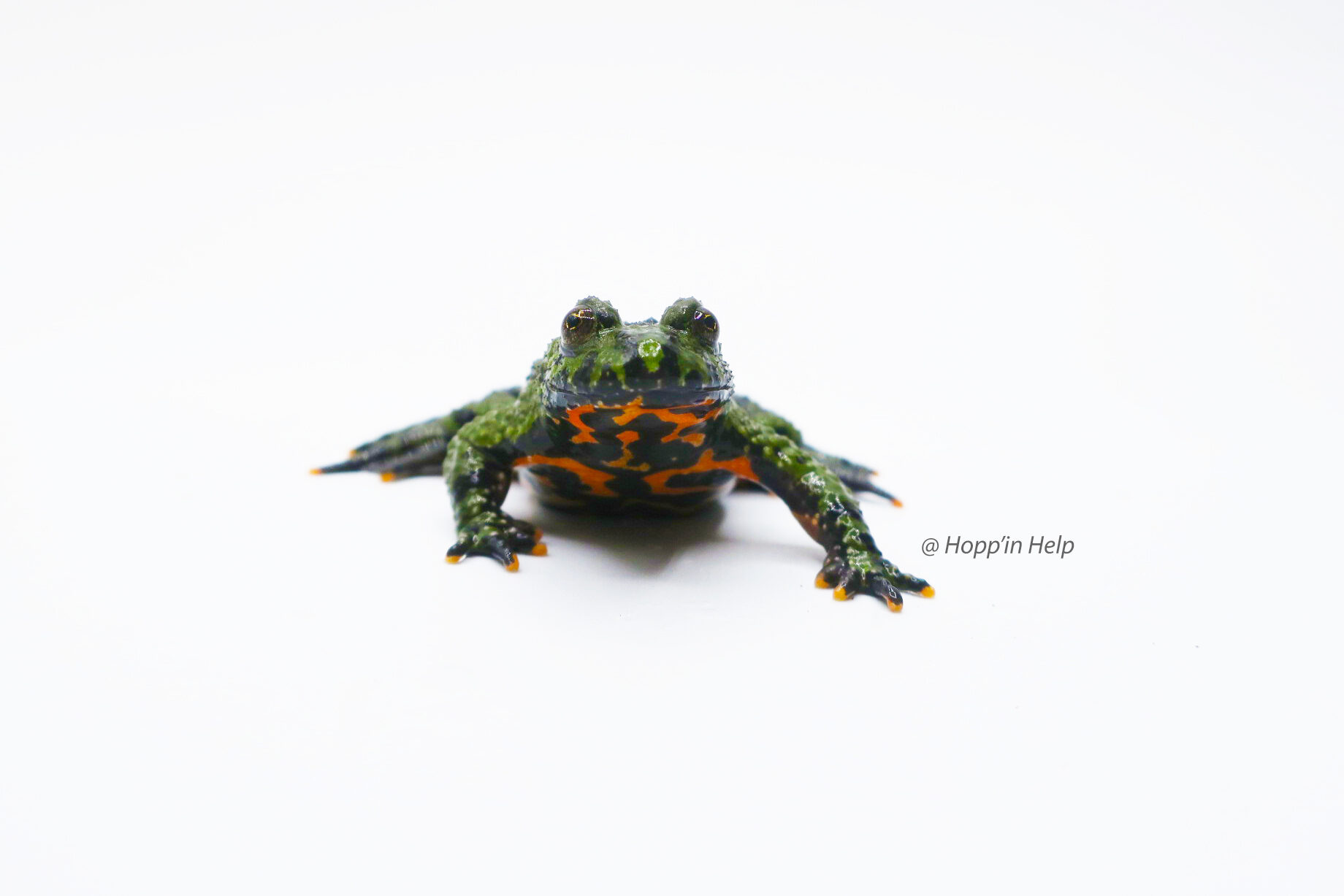
PERSONAL EXPERIENCE: Fire Bellied Toads are delightful addition to any herptile collection. I began my exotic animal ownership with this incredible species at quiet a young age and still have the original group to this day. Speaking from my own experience, this species is great for new amphibian owners and sure to bring joy to anyone whom may own them!
CAPTIVITY DIFFICULTY: Beginner
LIFE SPAN: 12-15 years
ACTIVITY: Unlike most common captive amphibian species, Fire Bellied Toads are diurnal. Meaning they are active during daylight hours. You will find them soaking, basking, hunting, and calling for mates from dawn to dusk. Fire Bellied Toads are also highly social and should always be kept in pairs or groups.
ENCLOSURE: Fire Bellied Toads are semiaquatic species, relying equally on access to fresh water and terrestrial land. A paludarium or a terrestrial tank that incorporates a 50:50 ratio of land to water is ideal. Focusing on the aquatic portion, large river rocks or slate stone slabs make a perfect substrate. If you are looking to keep live plants, placing a level of aquarium stratum and then the rocks of choice. I personally suggest Fluval Plant and Shrimp Stratum. This promotes plant health and growth and will be passed by the frog if accidentally ingested. Dwarf Hairgrass, Java Moss, and Sagrittaria Subulata are perfect choices for fully submerged plants. Fire Bellied Toads spend most of their time in the water and need places to rest from swimming. Rocks, aquarium decor, and live plants the rest just below or above the surface are perfect areas for your Fire Bellies to rest. A type of filtration is required to keep the water moving (waterfall, fountain, etc.) I personally use the TetraFauna Decorative Reptofilter. I have had this product for years and it works great and it is very quiet! Rinse filters monthly and replace completely every 6 months. If you are using tap water for your enclosure, water conditioner must be used. This removes harmful chemicals and makes the water safe for your amphibian. Directions vary so be sure to read the label before using. Focusing on the land portion, coconut fiber substrate, or a natural soil substrate is best for the bedding. Live plants may also be incorporated. Parlor Palms have always done best with my Fire Bellied Toads. The land portion will also need to have areas for your frogs to hide. Logs, hides, aquarium decor, and driftwood all make excellent hiding places.
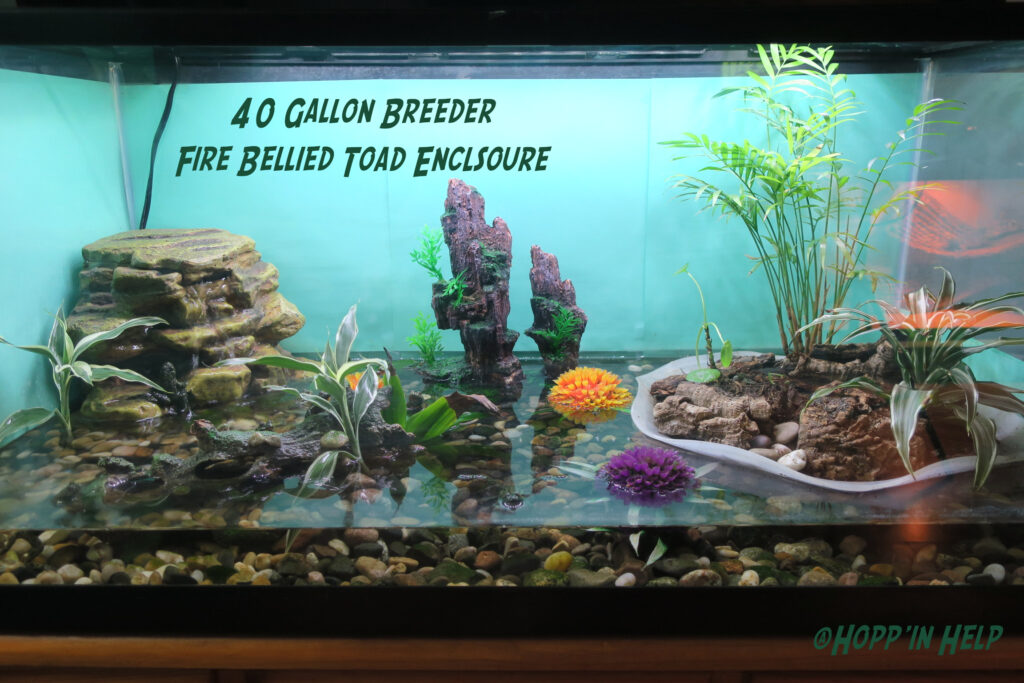
SIZE OF ENCLOSURE: A pair of Fire Bellied Toads should have minimum of 10 gallons, 20 x 11 x 13 inches, 50.8 x 27.94 x 33.02 cm. The width of an enclosure should increase exponentially with the addition of more frogs. For example, 10 Fire Bellied Toads comfortably in a 40-gallon breeder enclosure.
HUMIDITY: 60-80% A large water feature assists in raising and maintaining humidity levels.
WATER TEMPERATURE: 70-75 degrees F (21-24 C) A heat source is typically not needed for Fire Bellied Toads as they thrive at ambient room temperature. However, keep a thermostat within the tank to ensure proper water temperature.
TEMPERATURE: Daytime temperatures of 70-75 degrees F (21-24 C) are ideal. This species is tolerant to a large range of temperatures but the temperature should never exceed 80 degrees F (27 C). A basking light is not needed. Fire Bellied Toads thrive at room temperature and are a cold-resistant species.
Nighttime temperatures should never drop below 65 degrees F (18 C). A low watt heat emitter that is scheduled for the times the temperature drops too low may be used in winter months. Excess heat leads to the drying out of the enclosure and can be deadly to amphibians.
LIGHTING: Fire Bellied Toads are a diurnal species. Visible light must be provided for 12 hours daily to maintain your frogs natural circadian rhythm. 12-13 hour light cycles mimic summer conditions and can prevent brumation. Shorter light cycles of 8-10 hours mimic winter months which can result in symptoms like hunger strikes. A full spectrum grow light is best to sustain plant growth within your enclosure.
A heat lamp is never necessary unless temperatures drop below 65° F. A low wattage heat emitter set on a timer may be used in winter months. Unnecessary heat can result in drying of the enclosure, which may be fatal to amphibians.
UVB lighting is an essential aspect to the wellbeing of certain captive reptiles and amphibians. However, the quantity of which each species requires has not been heavily researched. Exposure to UVB allows for the synthesis of vitamin D3 within their skin. An essential micronutrient needed to metabolize calcium for healthy bone development, muscle function, immune function, and overall growth. Vitamin D may also be obtained through diet. It is dependent on the species whether diet supplementation of D3 can sustain proper vitamin D values. Too great of UVB exposure can have negative effects including but not limited to ocular damage and cancer. There is currently no research that specifies whether Fire Bellied Toads benefit from UVB lighting more than diet supplementation. Due to this lack of information, a safer route of providing your toad with Vitamin D would be through the diet. Continue reading to the “supplement” section for more important information on calcium and vitamin D3.
FEEDING: Live crickets or roaches should be 90% of their diet as they are low in fat and high in protein. An adult Fire Bellied Toad should have 3-4 crickets/roaches every 2-3 days. Dusting your feeds with calcium improves your frogs’ health and growth. Mealworms, Wax worms, Red Wigglers, moths, and Phoenix worms can be given as snacks occasionally. A diverse diet improves your frogs’ health through nutrients and hunting stimulus.
SUPPLEMENTS: A vital aspect of maintaining your amphibian’s health in captivity is supplementing their diet with powdered vitamins and minerals. Meeting proper habitat requirements alone will not provide essential nutrients for them to thrive.
Powdered supplements should be dusted onto your amphibian’s meal at every feeding. Calcium is the most important nutrient amphibians receive primarily from the supplements you place on their food. It helps ensure proper bone growth and density, muscle and nerve function, and overall metabolic function. Herptiles without proper calcium levels can develop nutritional secondary hyperparathyroidism (NSHP) or more commonly known as metabolic bone disease (MBD). NSHP is a specific kind of MBD commonly seen in captive reptiles and amphibians. Here the parathyroid glands overcompensate for the lack of calcium, ultimately resulting in bone weakening as the body essentially “steals” calcium from the bones.
Thankfully with a proper diet, NSHP can be avoided altogether. Powdered Calcium supplements are commonly sold in two forms, with D3 and without D3. Amphibians kept with UVB should be given calcium without D3 to avoid possible overdosing of the vitamin. Research has found that naturally produced D3 in the body is safer and more effective than orally supplemented D3. However, for the reasons listed in the “lighting” section, amphibian owners have the best success with oral supplements with products available currently.
In addition to calcium with D3; vitamin A, and multivitamins should be given periodically.

What size insects do I get for my Fire Bellied Toad? A general rule for feeding Reptiles and Amphibians is, the food in question’s girth should fit in between the animal’s eyes. Fire Bellied Toads do well with 1/4-1/2 crickets and dubia roaches.
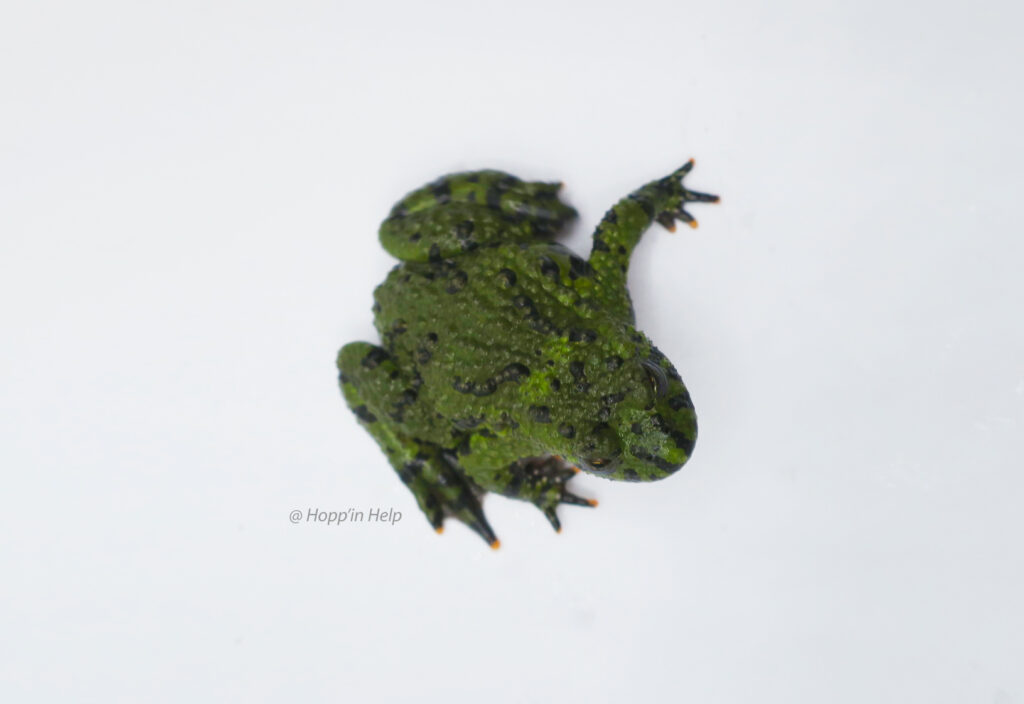
HOW TO SEX: Males have thick forearms and produce larger bumps on their back from April-August during mating season. Males also are very vocal year-round. Their mating call sounds like a dog barking off in the distance. Other noises include a water drop sound.
Females have smoother skin and slimmer forearms. Females do produce sound when agitated. However females never take part in grasping “hugging”, the position they mate in. However, males will grasp both other males and females but females never “hug”.
SIZE: The typical length for an adult Fire Bellied Toad is 1in – 2 inches (2.5cm – 5cm)
I AM NEW TO FROGS, ARE THEY GOOD FOR BEGINNERS?
Fire Bellied Toads are my first recommendation for new exotic pet owners! Compared to other species, they have relatively simple care with easily maintainable enclosure requirements. In addition to being a social species that allows one to house multiple of the same species and will be active during the day. With vivid colors and matching personalities, this species would be a great choice for those entering the herptile hobby world.
ABOUT THE AUTHOR: Hello! My name is Madison with my family of Fire Bellied Toads. Adopted in 2007, these 10 frogs were my first exotic species. It has been an honor to grow with them and nearly 18 years later, have 6 still with me today. I formulated this care sheet from personal experience and experts’ advice to provide the best personalized care. If you have any further questions, feel free to directly email me through the “contact” tab.
References:
https://joshsfrogs.com/care-sheet/fire-bellied-toad-care-sheet